
12 Old Household Tricks That Still Work Better Than Modern Products
Time-tested methods for cleaning, preserving, and caring for your home—simple solutions that outperform their modern counterparts.
There's a particular kind of satisfaction in discovering that something your relatives did for decades actually works better than the expensive product sitting on store shelves today. Not because of nostalgia or sentiment, but because it genuinely solves the problem more effectively, costs less, and often proves gentler on your hands, your home, and the environment.
The household wisdom that gets passed along through families exists for a reason. These methods have been tested by thousands of people across generations, refined through trial and error, and kept alive because they deliver results. They work within the logic of how things actually behave—how wood swells and contracts, how salt draws out moisture, how acid cuts through grease, how time and patience accomplish what force cannot.
What follows aren't tips you'll find on every lifestyle blog. They're specific, practical applications of this tested knowledge, with the reasoning behind them so you understand not just what to do, but why it works.
1. Salt and Vinegar for Cast Iron That Actually Stays Seasoned
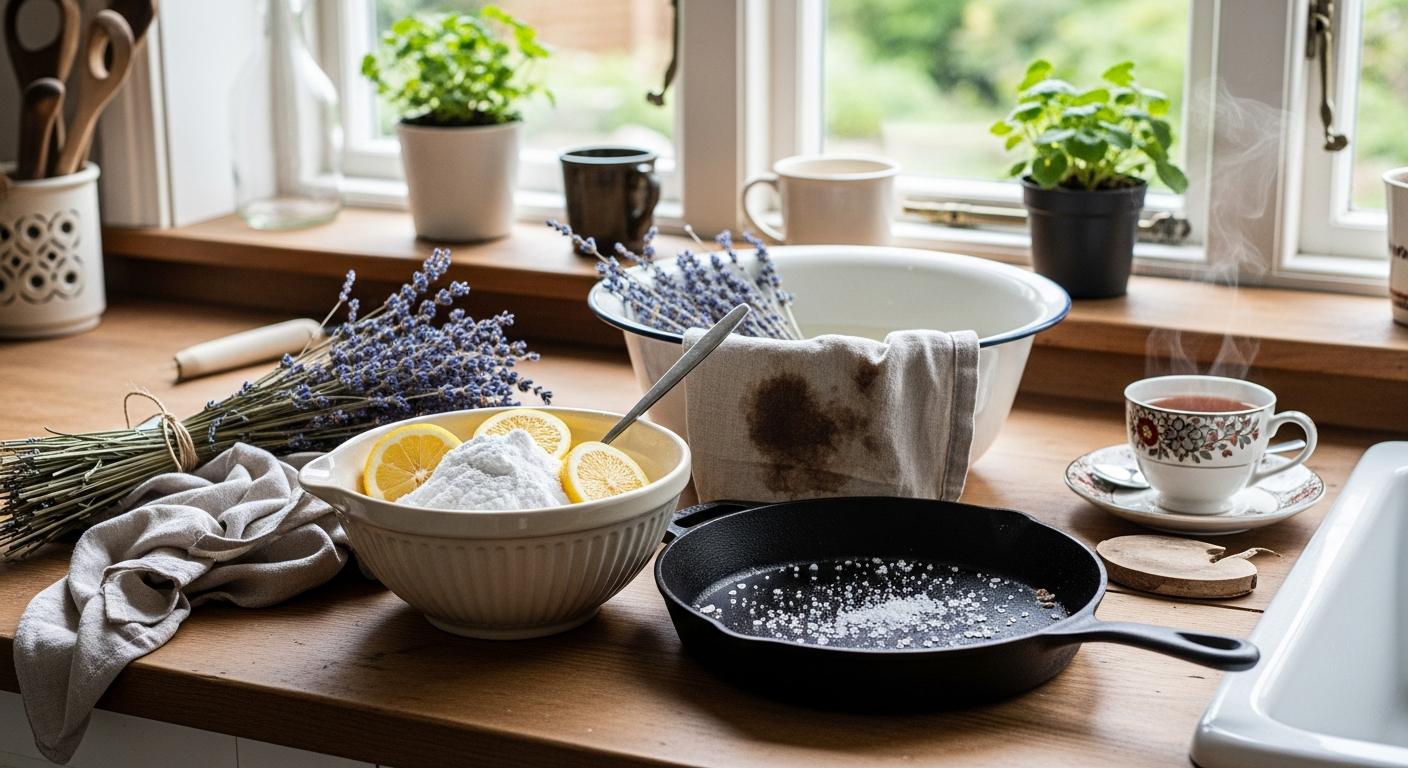
Cast iron maintenance has become needlessly complicated. Modern advice often recommends special oils, specific temperatures, and elaborate seasoning protocols. The traditional method is simpler and more effective: coarse salt and a small amount of vinegar, applied while the pan is still warm.
Here's what actually happens. Salt acts as an abrasive that removes stuck-on food without scratching the iron, while the vinegar cuts through oxidation. The warmth helps the salt work without requiring scrubbing force. You wipe it dry immediately, then apply a thin layer of whatever fat is convenient—lard, bacon grease, or neutral oil. The key is "thin." Too much oil turns rancid and builds up in layers. One proper, thin application, wiped to a shine, is far better than multiple heavy coats.
The reason this works better than modern products: it removes buildup without stripping the seasoning you've already developed, then adds minimal, fresh oil that polymerizes evenly. Commercial cast iron cleaners often leave residue, and specialty seasoning oils are marketed as superior when basic fat has been doing the job for over a century.
2. Newspaper for Streak-Free Windows
Every cleaning expert will tell you this works, yet it remains surprising how few people actually use it. The reason newspaper works where paper towels fail comes down to paper fiber structure.
Newspaper has a slightly rougher, more compressed surface than modern paper towels. This texture grips moisture and moves it along the glass without leaving behind the fuzzy residue that paper towels deposit. The ink also plays a small role—it's slightly abrasive and helps polish away streaks. When you use newspaper with a simple solution of vinegar and water (or even just water and a bit of rubbing alcohol), you're not fighting against your cleaning tool; it's actually assisting the process.
The real value here isn't just that it works—it's that you probably have newspaper available or can easily get it. You're also reducing waste by reusing something already in your home.
3. Baking Soda and Heat for Oven Cleaning
Commercial oven cleaners are often caustic enough to damage your skin, and they leave chemical residue in the space where you cook food. The old method of baking soda paste applied the night before requires patience but produces superior results with zero toxicity.
Make a paste of baking soda and water, apply it generously to the interior (avoiding heating elements), and let it sit overnight. The baking soda is mildly alkaline and slowly loosens baked-on residue through chemical action rather than harsh fumes. In the morning, spray vinegar over the dried paste. The chemical reaction creates a fizz that further loosens grime, and the combination is now easier to wipe away. This works because you're using chemistry appropriately scaled to the task—not an industrial-strength caustic, but a gentle base-acid reaction that takes time but achieves thorough cleaning.
Modern oven cleaners work faster because they're stronger, not because they're smarter. If you have the evening and morning to spare, baking soda accomplishes the same goal while you can safely touch the oven without gloves.
4. Bread for Broken Glass
If you've broken a glass and can't find every piece, a slice of soft bread swept gently across the floor will catch glass shards that a broom misses. The soft crumb is sticky enough to adhere to tiny fragments without being stiff enough to shatter them further, and it conforms to crevices where rigid tools won't reach.
This works because of basic material properties: soft deformability combined with slight tackiness. Modern alternatives like rubber brooms work similarly, but bread is free, requires no equipment, and is digestible if a pet accidentally consumes a small piece (whereas rubber can be harmful). It's a perfect example of how the simplest solution is often already in your kitchen.
5. Lemon and Salt for Cutting Boards
Wooden cutting boards absorb stains and hold odors. Harsh bleach damages wood and leaves chemical residue. The combination of lemon juice and coarse salt actually works better than either alone.
Salt is mildly abrasive and antimicrobial. Lemon juice is acidic and cuts through oils while its natural bleaching properties lighten stains. When used together on a damp board, they scrub away stains while the acidity disinfects. The salt dissolves slightly into the lemon juice, creating a slightly thickened paste that doesn't immediately drip away, giving it time to work. Rinse thoroughly with hot water afterward.
This method cleans, deodorizes, and preserves the wood in a single action. It requires ingredients you already have and produces no toxic runoff.
6. Vinegar and Baking Soda for Drains
The fizzing action of vinegar and baking soda has become somewhat clichéd, but it genuinely works better than liquid drain cleaners for maintenance and minor clogs. Here's why it's effective: the chemical reaction creates carbon dioxide gas, which creates pressure that dislodges debris without the destructive force of commercial drain cleaners.
Pour boiling water down the drain first to soften buildup. Add a cup of baking soda, then pour in vinegar (it will fizz dramatically). Cover the drain and let it work for 15-30 minutes. The fizzing action breaks apart hair clogs and soap buildup far more effectively than you might expect. Finish with more boiling water to flush everything through.
Commercial drain cleaners work by dissolving organic material through caustic chemistry—which works quickly but can damage pipes over time and creates hazardous fumes. The vinegar-and-soda method is gentler on pipes, safer to handle, and surprisingly effective for regular maintenance.
7. Cornstarch for Grease on Fabric
Getting grease out of clothing requires understanding that grease is hydrophobic—it repels water, which means washing immediately often sets the stain. The traditional solution is cornstarch, which absorbs grease before water ever touches it.
Sprinkle cornstarch generously on the fresh grease stain and let it sit for 15-30 minutes. The starch absorbs the oil, which you then brush or vacuum away. Only after this step should you wash the garment. This pre-treatment works because you're removing the bulk of the grease mechanically before introducing water, which would spread it deeper into fibers. Talcum powder works similarly if you don't have cornstarch.
Modern stain removers work partly through detergents that break down grease and partly through solvents. Cornstarch works through absorption, which is actually the most efficient first step. Many people who think they can't remove grease stains simply skip this step and go straight to water.
8. Tea for Wood Color
Scratches and pale spots on wood furniture can be toned using strong brewed tea—specifically black tea, which contains tannins that stain wood. This isn't a permanent fix for deep damage, but for superficial marks and color evening, it's remarkably effective.
Brew strong black tea, let it cool slightly, and apply it with a soft cloth to the affected area. The tannins gradually darken the wood to match the surrounding finish. You can control darkness by applying multiple coats. Test on an inconspicuous spot first because wood color varies, but the method is so gentle that mistakes are easily corrected with a damp cloth.
This works because tannins are a natural wood stain—they're what's used in professional wood finishing. You're not applying a surface coating but actually tinting the wood slightly, which creates a more seamless repair than modern touch-up markers.
9. Chalk for Grease Prevention
A stick of chalk placed in a kitchen cupboard, under a bathroom sink, or anywhere moisture tends to accumulate absorbs humidity and prevents mold and mildew. It's not a solution for major moisture problems, but for normal household dampness, it's preventative and free.
Chalk is porous—it absorbs water vapor directly from the air through capillary action. When saturated, you simply replace it. This addresses the root cause of mold growth (excess moisture) rather than treating mold after it appears. Modern silica gel packets work on the same principle, but chalk costs almost nothing and biodegrades when discarded.
10. Butter for Removing Labels and Sticky Residue
Adhesive residue from labels and stickers clings because it's oily and sticky. Water doesn't help because adhesive is hydrophobic. Butter, being fatty, dissolves adhesive far more effectively than dedicated products like Goo Gone.
Rub butter directly onto the sticky residue and let it sit for a minute. The oils penetrate and break down the adhesive bond, and you can then wipe it away with a cloth. This works on glass, plastic, wood, and painted surfaces without risk of damage. Olive oil works similarly if you don't want to use butter.
This is one of the clearest examples of how understanding the chemistry of a problem leads to the simplest solution. Adhesive responds to oils because they're chemically similar.
11. Newspaper Under Rugs for Non-Slip
Rugs sliding across floors is a safety hazard and an annoyance. Before commercial non-slip rug pads, newspaper served this purpose—and honestly still does better than some modern alternatives.
Place several layers of newspaper under the rug. The paper creates friction against the floor while being thin enough that it doesn't bunch up. As it ages and compresses, replace it. The advantage over rubber pads is that newspaper conforms to the exact floor beneath and never becomes tacky or leaves residue. It's free, easy to adjust, and creates genuine grip rather than just surface tackiness.
12. Boiling Water for Furniture Dents
Wood furniture sometimes develops small dents from impact. Modern advice often recommends special wood repair products, but steam accomplishes the same goal more effectively.
Boil a kettle and hold the spout near (not touching) the dented area. The steam penetrates the wood, which swells slightly from moisture absorption. The wood fibers, having absorbed water, expand and can fill in shallow dents. Let the area dry completely, and the dent will be less visible or gone entirely. For deeper dents, place a damp cloth over the area and use a hot iron (on low setting) to apply sustained heat and moisture.
This works because wood is hygroscopic—it absorbs and releases moisture, which causes dimensional changes. You're using this property intentionally to expand compressed fibers back to their original position. Modern wood fillers work by adding material; steam works by encouraging the existing wood to expand.
Why These Methods Endure
There's a pattern in what works: these methods respect the actual nature of materials, use chemistry appropriately scaled to the task, and require patience rather than force. They work with how things actually behave instead of against it.
The modern tendency is toward products that work faster, promise more, and advertise aggressively. But faster isn't always better, especially in a home where you live daily. A gentler method that takes an evening is often preferable to a harsh one that works in minutes. A solution using ingredients you already have reduces clutter, saves money, and eliminates the need to store specialized products.
These aren't secrets or lost knowledge. They remain effective because effectiveness doesn't change with marketing cycles. Using them is a small act of trust in accumulated experience, a reminder that some of the best solutions are already within reach.
Related articles

How Slow Cooking Improves Focus
Understand why pace matters in food preparation.
9 Things You Should Never Put in the Dishwasher—And Why Hand Washing Matters
Some kitchen items deserve the gentle care of hand washing. Learn which treasured pieces to protect and why this simple practice preserves what matters most.
The One Food You Should Never Reheat—and Why It Matters More Than You Think
Some kitchen rules exist for good reason. Learn which common food poses real danger when reheated and why this matters for your family's health.