
Grandma Knows: How to Remove Grease from Clothes
Grease stains on clothes are tricky but not impossible. Discover proven household methods using baking soda, dish soap, and patience.
Grease stains are among the most stubborn fabric stains because oil and water don't mix. Standard washing with water alone moves the stain around without removing it — the grease molecules remain clinging to the fabric fibers while water slides past them. To remove grease from fabric, you need something that can bridge the gap between the oil and water: a surfactant.
Understanding this chemistry isn't just academic. It explains why dish soap works so well on grease stains, why hot water helps in some cases, and why simply rinsing a greasy garment accomplishes almost nothing.
The Chemistry of Grease Stains
Oils and fats are nonpolar molecules, meaning their electrons are distributed evenly and they don't have the charged regions that allow them to interact with water. Fabric fibers, particularly synthetic ones, are also somewhat nonpolar, which is why grease adheres to them so readily.
Surfactants — the active compounds in soap and detergent — have a split personality. One end of a surfactant molecule is attracted to water; the other is attracted to oil. When surfactants contact a greasy stain, they surround the oil molecules with their oil-loving ends, forming small clusters called micelles. The water-loving ends of the surfactant then allow these oil-filled clusters to be rinsed away with water.
This is why dish soap, which is formulated specifically to cut through cooking grease, is particularly effective on grease stains in fabric.
Don't Rinse First
The instinct when something spills on clothing is often to run it under water. With grease stains, resist this impulse. Water doesn't dissolve grease, and wetting the fabric makes subsequent treatment slightly harder. More importantly, rubbing a wet grease stain spreads it and can drive it deeper into the fabric weave.
Instead, your first step should be to absorb as much of the fresh grease as possible.
Absorb Before You Clean
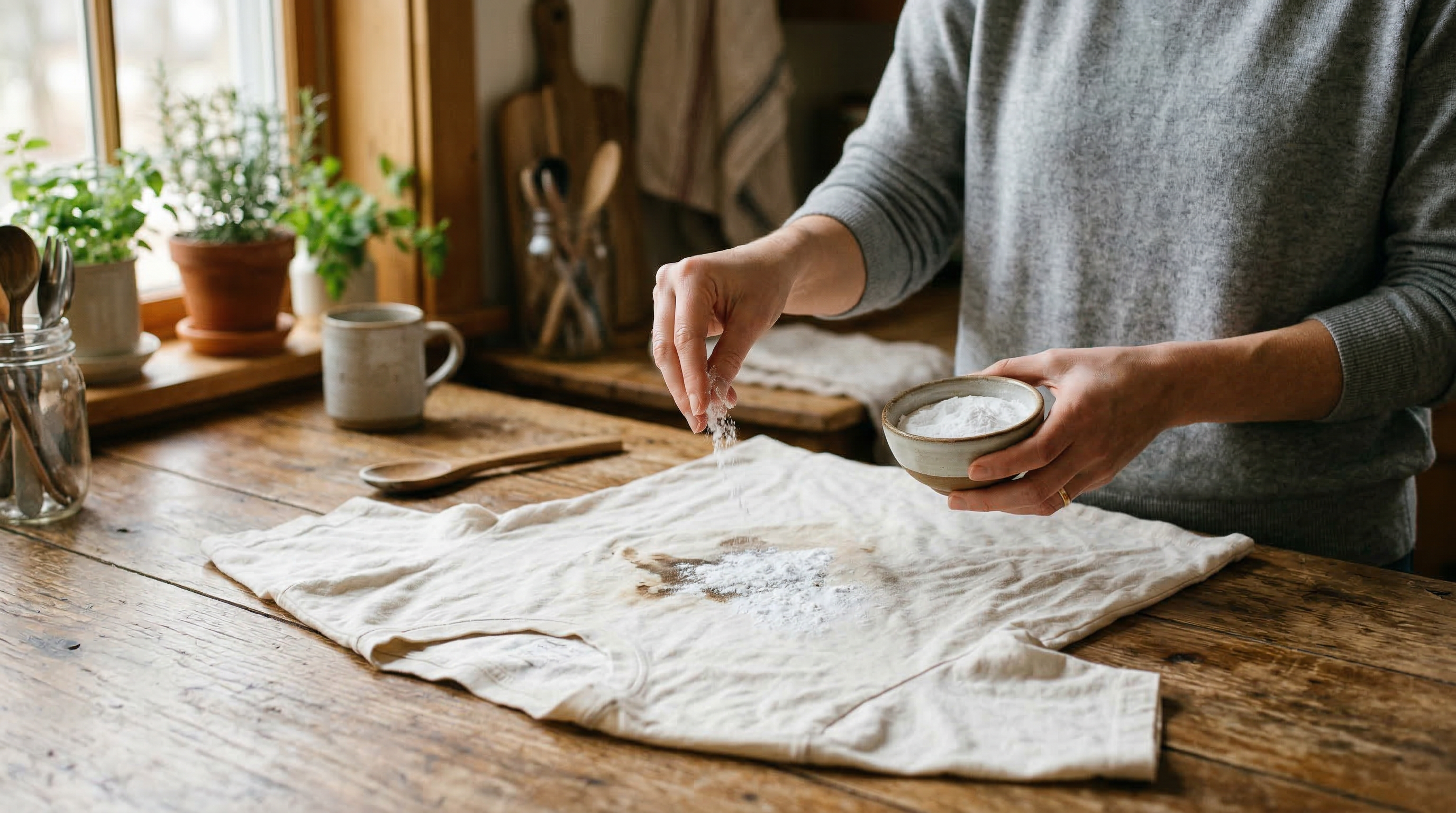
If the grease stain is fresh and wet, sprinkle an absorbent powder directly onto it. Baking soda, cornstarch, and talcum powder all work well. These powders pull liquid grease away from the fabric fibers through physical absorption.
Apply a generous layer and press it gently into the stain without rubbing. Let it sit for at least fifteen minutes — longer is better for a heavier stain. The powder will visibly darken as it absorbs the grease. Brush it off gently and repeat if significant grease remains. Only after this absorption step should you move to cleaning with soap.
Dish Soap: The Essential Tool
Apply a small amount of dish soap directly to the stain and work it into the fabric gently with your fingers or a soft brush. Use circular motions and work from the outer edge of the stain inward. The soap needs time to surround the grease molecules, so let it sit for ten to fifteen minutes before rinsing.
Rinse with warm water — not cold. Warm water increases the activity of the surfactants and also makes oils slightly less viscous, both of which aid removal. Rinse thoroughly from the back of the fabric, allowing water to push the loosened grease out through the same fibers it entered.
Check the stain after rinsing. If grease remains, repeat the dish soap treatment before moving to the washing machine. This is important: putting a still-stained garment in the dryer will heat-set the grease, making it much harder to remove on future attempts.
For Dried or Set Grease Stains
A dried grease stain requires softening before treatment. Apply dish soap to the dry stain and work it in thoroughly. Let it sit for thirty minutes to an hour — giving the surfactants time to work on the hardened grease. You can also apply a small amount of petroleum jelly or a similar oil-based product to the dried stain first: this re-liquefies the grease, paradoxically making it easier to then remove with dish soap.
For older, more stubborn grease stains, a pre-treatment with baking soda paste before applying dish soap can help. The mild abrasiveness of the baking soda loosens the surface of the dried stain while its alkaline properties support the soap's action.
WD-40 on Fabric: An Unusual Approach
This sounds counterintuitive, but applying a small amount of WD-40 or another light machine oil to a dried grease stain can make it treatable again. The principle is the same as using petroleum jelly — you're re-liquefying a dried oil stain so that it can be lifted by dish soap.
Apply a small amount to the stain, let it penetrate for a few minutes, then treat with dish soap as described above. This method works particularly well on motor oil and heavy grease stains on work clothes or overalls.
Laundry Detergent as a Pre-Treatment
Liquid laundry detergent can be applied directly to a grease stain as a pre-treatment. Rub it into the stain and let it sit before washing. Laundry detergents contain enzymes specifically formulated to break down oils and fats. For particularly stubborn grease stains, a dedicated enzyme pre-treatment spray applied generously and left for the maximum time recommended on the packaging will often succeed where other methods fall short.
Different Fabrics, Different Caution
Cotton and synthetic fabrics handle most of the above methods well. Wool requires more care — avoid hot water and harsh scrubbing, which can felt the fibers. Dish soap can be used gently on wool, but work slowly and rinse carefully. Silk is the most delicate and best treated by a professional dry cleaner, particularly for significant grease stains.
Down-filled items like jackets and bedding require special treatment. Grease in down can clump the fill and reduce its insulating ability. These items often need to be washed in a large-capacity machine with appropriate detergent, or professionally cleaned.
Checking Before Drying
After washing, check the stained area carefully before putting the garment in the dryer. Natural or artificial light shows grease stains more clearly than a wet garment allows. Run your fingers over the area — remaining grease has a slightly tacky or slick feel.
If you can feel or see the stain after washing, treat it again before drying. Once heat has been applied, the grease bonds much more firmly to the fabric and the stain may become permanent. This single habit — checking before drying — prevents most cases of permanently set grease stains.
Prevention in the Kitchen
Wearing an apron while cooking is the most straightforward way to keep grease stains off clothing. But accidents happen regardless, and for anyone who cooks regularly, grease stains are an occasional reality. A bottle of dish soap near the laundry area is a small preparation that makes a significant difference — the sooner you treat a grease stain, the better the result.
Related articles
Grandma Knows: How to Remove Tomato Sauce from Clothing
Tomato sauce stains are vivid and quick to set. Learn the right sequence of treatments to remove tomato stains from clothing before they become permanent.
Grandma Knows: How to Remove Grass Stains from Clothes
Grass stains on clothes are stubborn but very treatable. Learn the household methods that break down chlorophyll and get fabric clean again.
Grandma Knows: How to Remove Blood Stains from Fabric
Blood stains on fabric respond to cold water and the right approach. Learn which methods work on fresh and dried blood without damaging your clothes.