
Grandma Knows: How to Get Ink Off Hands
Ink on your hands won't budge with plain soap? Here are practical, proven methods to remove ink stains using everyday household items.
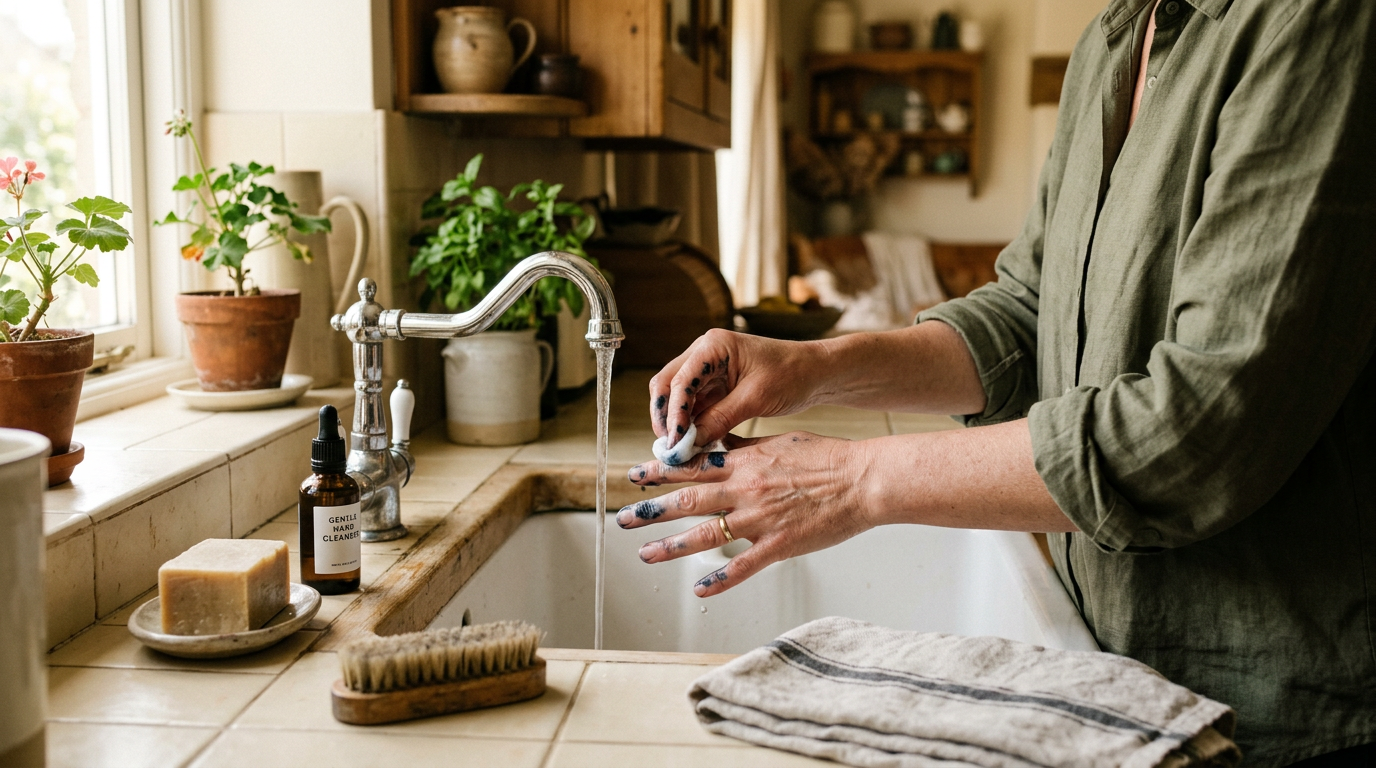
Ink has a way of ending up exactly where you don't want it. You're signing a stack of papers and the pen leaks. You're helping a child with an art project and suddenly your hands look like a canvas. You change a printer cartridge and, despite your best efforts, your fingers are stained dark blue or black before you've even finished the job.
Plain soap and water rarely do much. You scrub, rinse, and look down to find the ink is still very much there. That's not a failure on your part — it's simply a matter of chemistry. Ink is designed to stay put. Understanding why it sticks so stubbornly is actually the first step toward getting rid of it.
Why Ink Sticks to Skin
Most everyday inks — the kind in ballpoint pens, markers, and printer cartridges — are made with pigments or dyes suspended in a carrier liquid, along with binders and resins that help the ink hold its shape on paper. When ink lands on skin, that carrier liquid evaporates quickly, and what's left behind are the pigment particles and resin.
Skin has a slightly rough, porous texture at the microscopic level. Ink particles settle into those tiny grooves and bind to the natural oils on the surface of your skin. Water alone can't break that bond because many ink components are oil-based or resin-based, and water doesn't dissolve oils. That's exactly why washing your hands with ordinary soap gives you only partial results at best.
The good news is that the same properties that make ink stick — its relationship to oils and resins — also point toward solutions. The right household substance can break down the resin, dissolve the oily carrier, or lift the pigment from the surface of the skin without causing irritation.
Rubbing Alcohol: The Most Reliable Starting Point
Isopropyl alcohol, commonly sold as rubbing alcohol, is one of the most effective tools for removing ink from skin. It works because alcohol is a solvent — it dissolves the resin and oil-based components of ink, loosening the pigment from the skin's surface so it can be wiped away.
You don't need anything fancy. Standard 70% isopropyl alcohol from the medicine cabinet works well. Higher concentrations (90% or above) work slightly faster but are harder on the skin with repeated use.
Here's how to use it properly:
- Pour a small amount of rubbing alcohol onto a cotton ball or a folded piece of paper towel.
- Press it gently against the ink stain and hold it there for about ten seconds. This gives the alcohol time to start breaking down the resin before you begin rubbing.
- Rub in small circular motions, applying light pressure. You should see the ink transferring onto the cotton ball.
- Use a fresh cotton ball if the first one becomes too saturated with ink. Rubbing with an ink-soaked pad just spreads the stain.
- Once the ink is gone, wash your hands with mild soap and water, then apply a small amount of hand lotion. Alcohol strips natural oils from skin, and moisturizing afterward keeps your hands from drying out.
This method works best on fresh ink and on most ballpoint pen and printer ink types. It works less well on permanent marker, which contains stronger dyes designed to resist solvents. For permanent marker, alcohol is still worth trying first, but you may need to follow up with one of the other methods below.
Hand Sanitizer as a Practical Substitute
If you don't have rubbing alcohol on hand, gel hand sanitizer is often within reach — in a bag, on a desk, or near the kitchen sink. Most hand sanitizers are between 60% and 70% alcohol, which is enough to dissolve ink effectively.
The gel formula actually works slightly better for this purpose than liquid alcohol in some situations because it stays on the skin longer rather than evaporating immediately. Apply a generous amount directly to the ink stain, rub it in for about twenty to thirty seconds, then wipe clean with a dry cloth or paper towel. Rinse well afterward.
This is a particularly useful method when you're away from home — at an office, school, or while traveling — because hand sanitizer is widely available and easy to carry.
Cooking Oil and Dish Soap: A Gentle Two-Step Method
For people with sensitive skin, or when alcohol isn't available, a combination of cooking oil and dish soap is a surprisingly effective approach. This method takes a little more time but is much gentler on the skin.
The logic is straightforward. Cooking oil — olive oil, vegetable oil, or coconut oil all work — bonds with the oily components in ink and loosens the pigment from your skin. Dish soap then emulsifies the oil, meaning it surrounds the oil droplets and allows water to rinse everything away cleanly.
To use this method:
- Apply a small amount of cooking oil directly to the ink stain. About half a teaspoon is usually enough for a few fingers.
- Rub the oil into the stained area for a full minute. Work it into the creases of your knuckles and around your fingernails, where ink tends to collect.
- Without rinsing off the oil, apply a drop of dish soap directly on top of the oily area.
- Rub the soap and oil together for another thirty seconds. You'll feel the mixture become slightly slippery and then begin to emulsify.
- Rinse thoroughly under warm running water. The ink should come away with the oil and soap.
This method works especially well for water-based inks, like those found in many modern rollerball pens and some markers. It's also a good choice for removing ink from the hands of children, since it involves nothing more than food-safe oil and ordinary dish soap.
One practical note: this method may take two rounds if the ink stain is heavy. Apply the oil a second time if any pigment remains after the first rinse.
Baking Soda Paste: A Mild Abrasive Approach
Sometimes ink works its way into the texture of your skin — into the lines of your palm, around the nails, or in the rougher skin near your knuckles. In these cases, a mild physical scrub can help lift the pigment that chemical methods leave behind.
Baking soda makes an effective gentle abrasive when mixed with a small amount of liquid soap or dish soap. The fine grit of the baking soda helps physically dislodge ink particles from textured skin surfaces, while the soap helps carry them away.
Mix about a teaspoon of baking soda with just enough liquid soap to form a thick paste. Apply it to the stained area and scrub gently with your fingertips for thirty to sixty seconds. Rinse well. The combination of mild abrasion and soap is often enough to clear what other methods left behind.
This method is not appropriate as a first step on irritated or broken skin. Baking soda paste should be saved for use on normal, intact skin, and it should feel gently scratchy — not painful. If it stings, rinse immediately.
Hairspray: An Old Trick That Still Has a Place
Hairspray has been used as an ink remover for decades. Older formulas contained high concentrations of alcohol, which made them quite effective. Many modern hairsprays have lower alcohol content as the formula has shifted toward conditioning ingredients, so results can vary depending on the brand you have at home.
If the hairspray you have is the firm-hold, aerosol type — especially an older or less expensive variety — it may still contain enough alcohol to dissolve ink reliably. Spray a small amount onto the stain, wait ten seconds, then rub with a cloth and rinse.
If you have a gentler or conditioning-style hairspray, the results may be minimal. In that case, skip it and use rubbing alcohol directly instead. The underlying reason hairspray ever worked was the alcohol content, so if that's reduced, so is the effectiveness.
Nail Polish Remover: Use With Care
Acetone-based nail polish remover is a powerful solvent that can dissolve stubborn ink, including permanent marker. It works quickly and effectively on most ink types.
However, acetone is harsh on skin. It strips away natural oils aggressively and can cause dryness, cracking, and irritation with repeated use or prolonged contact. It should only be used as a last resort when other methods haven't worked, and only on small areas for a short time.
Apply a tiny amount to a cotton ball, press gently on the stain, and wipe away. Rinse immediately and thoroughly with soap and water. Follow with hand lotion. Do not use acetone on chapped, dry, or sensitive skin.
Non-acetone nail polish remover is gentler but also less powerful. It may work on lighter ink stains but will likely struggle with permanent marker or heavy ballpoint ink.
What to Do When Ink Gets Under the Nails
Ink under and around the fingernails is one of the most stubborn situations. The area is hard to scrub properly, and ink can settle into the gap between the nail and the skin underneath.
The most practical approach here combines soaking with targeted scrubbing. Fill a small bowl with warm water and a generous squeeze of dish soap. Soak your fingertips for three to five minutes to soften any dried ink. Then use an old toothbrush — kept near the sink specifically for cleaning tasks — to gently scrub around and under the nails with a small amount of baking soda paste.
Work slowly and in small circular motions. Don't force the toothbrush under the nail aggressively; a gentle approach over a slightly longer time works better and avoids irritating the delicate skin at the nail edge.
If ink has stained the nail itself — common with certain markers — a cotton ball with a small amount of rubbing alcohol, held in place for thirty seconds before rubbing, usually clears it without damaging the nail.
Matching the Method to the Ink Type
Not all ink behaves the same way, and knowing what type of ink you're dealing with helps you choose the right approach from the start.
Ballpoint pen ink is oil-based and responds well to rubbing alcohol, hand sanitizer, or the oil-and-dish-soap method.
Rollerball and gel pen ink is water-based and often comes off more easily. Dish soap and warm water may be enough, and the oil method works well too.
Fountain pen ink is water-based and usually the easiest to remove. Soap and warm water, or the oil method, typically clear it without needing anything stronger.
Permanent marker contains strong dyes and binders designed to resist removal. Rubbing alcohol is the first choice, followed by nail polish remover if needed. Baking soda scrub can help with residual staining.
Printer ink and toner vary depending on the printer type. Inkjet printer ink is water-based and responds to soap and warm water or the oil method. Laser toner is a powder that fuses when heated and can be particularly stubborn — rubbing alcohol usually works, but you may need two or three rounds.
A Few Practical Habits That Help
If you work regularly with pens, markers, or printers, a few small habits make a real difference in how easy it is to keep your hands clean.
Act quickly when ink gets on your hands. Fresh ink — ink that hasn't fully dried and set — is significantly easier to remove than ink that has been sitting on skin for an hour or more. A quick wipe with a damp cloth immediately after contact can prevent a stubborn stain entirely.
Keep a small bottle of rubbing alcohol near your work area if you handle pens or cartridges regularly. Having it within arm's reach means you can treat a fresh stain in seconds rather than walking to another room and losing time.
If you're changing a printer cartridge, wearing disposable gloves is the simplest solution of all. A single pair of nitrile gloves takes seconds to put on and keeps your hands completely clean. They're inexpensive and worth keeping in a kitchen or home office drawer for exactly this kind of task.
For stubborn residual staining that persists after cleaning — a faint shadow of color that won't quite disappear — the best approach is often patience. Skin naturally exfoliates over a day or two, and what remained after cleaning will usually fade on its own. Normal handwashing throughout the day speeds this process along.
Related articles
Grandma Knows: How to Remove Tomato Sauce from Clothing
Tomato sauce stains are vivid and quick to set. Learn the right sequence of treatments to remove tomato stains from clothing before they become permanent.
Grandma Knows: How to Remove Grass Stains from Clothes
Grass stains on clothes are stubborn but very treatable. Learn the household methods that break down chlorophyll and get fabric clean again.
Grandma Knows: How to Remove Grease from Clothes
Grease stains on clothes are tricky but not impossible. Discover proven household methods using baking soda, dish soap, and patience.